case study | industrial
Industrial Yard Wi-Fi for Payments and Inventory Across 20 Acres
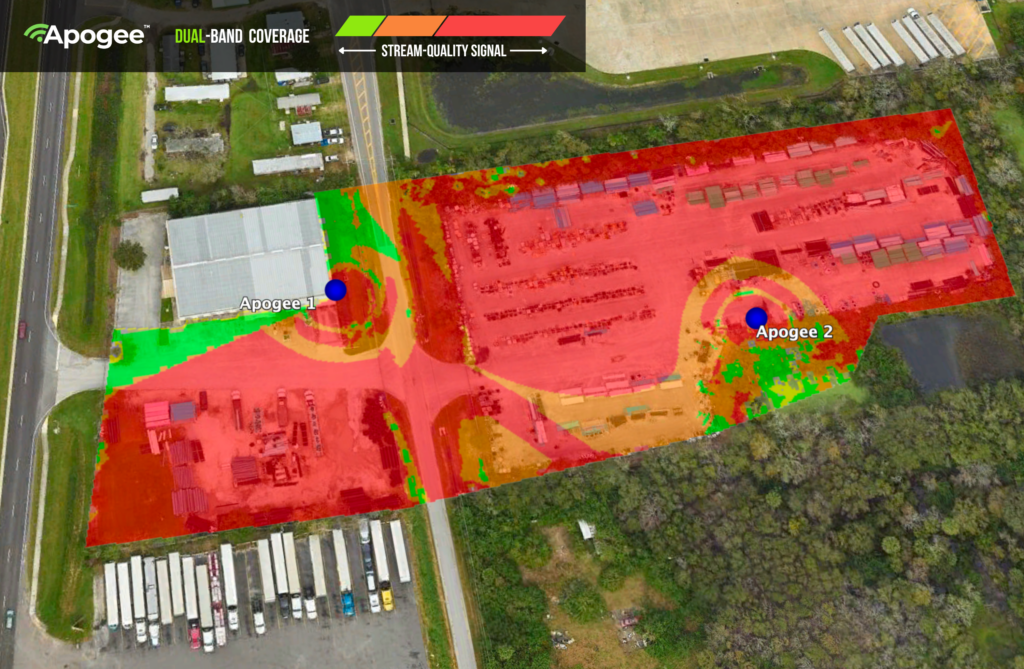
Two Apogee antennas connected industrial yard Wi-Fi across 20 acres for outdoor payments, inventory scans and delivery processing around metal stock.
Published
At this 20-acre industrial yard, a worker could start a transaction outdoors and have to return to the warehouse to finish it. Point-of-sale devices dropped offline around the metal inventory. Deliveries backed up, and inventory work slowed while people looked for a connection.
Industrial yard Wi-Fi had to reach the areas where materials were sold, received and moved. Steel, stacked stock and heavy equipment made those areas difficult to serve, and the working layout kept changing as inventory moved through the property.
Aura Wireless used two Apogee antennas to provide coverage across the yard. Staff could complete payments, scan inventory and post updates where the work was taking place.
When a lost connection holds up the next step
The coverage problem affected more than one device or department. A payment could wait on a connection. An arriving delivery could wait on processing. An inventory update could wait until a worker reached the warehouse again.
Each interruption put another step between the job and its completion. Walking back indoors might get a device online, but it took the employee away from the material, customer or delivery they were handling.
The deployment focused on making those outdoor areas useful for connected work. That included the yard’s staging areas and the seasonal or overflow zones used as operating needs changed. The objective was to let the devices follow the work across the property.
Designing industrial yard Wi-Fi around steel and movement
Two Apogee antennas served this 20-acre installation. The useful technical question is how to maintain communication with the handheld devices among the materials, equipment and changing signal paths.
Apogee’s Asymmetric Gain helps the network receive the weaker signals sent back by low-power devices. That matters when a handheld point-of-sale unit needs to complete a two-way exchange outdoors. A signal reaching the handheld is only part of the connection.
Metal can obstruct radio paths and reflect signals in different directions. Antenna placement and the chosen configuration need to account for those conditions. The presence of steel does not establish that every coverage problem has the same cause or needs the same equipment arrangement.
Filtering addresses another part of the radio environment. Apogee’s Steep Powered Filters reduce unwanted out-of-band signals. Filtering does not eliminate metal reflections or all interference. The coverage plan still needs to be checked against the actual places employees use their devices.
The two Apogees are antennas. Their coverage contribution does not establish how many access points, network links or other components another yard would require.
Payments and inventory updates stayed with the work
After deployment, point-of-sale devices stayed connected for sales in the yard. Workers could scan and update inventory in real time, and arriving deliveries could move through processing with fewer interruptions caused by lost coverage.
The source also describes supervisors gaining visibility into material movement and staging activity. Seasonal and overflow areas could support connected work, giving the operation more usable space for the tasks already being carried out there.
For a yard manager, those are practical improvements: finishing a transaction beside the inventory, posting a scan when material moves, and keeping a worker with the job instead of sending them back to reconnect. The case supports those workflow results without assigning an unsupported savings figure to them.
Questions about the industrial yard installation
How much area did the two Apogees cover?
Two Apogee antennas covered this 20-acre metal-dense industrial yard. That equipment count is specific to this deployment. Another property needs a plan based on its materials, layout, mounting options and devices.
What equipment did employees use on the network?
Employees used handheld point-of-sale devices for transactions and devices for scanning and updating inventory. The source also describes delivery processing and supervisor visibility into yard activity. It does not identify device makes or models.
Did the antennas eliminate interference from metal?
The deployment improved device connectivity around metal inventory. Apogee’s filters target unwanted out-of-band signals; they do not remove metal reflections. Coverage around steel still depends on the site and installation.
Read Aura’s outdoor wireless network overview and how Apogee works for more detail. To plan coverage where payments and inventory work happen, talk with Aura Wireless about your yard and its daily device use.