case study | municipal
Ashland Municipal Wi-Fi Supports Connected Field Teams
Ashland municipal Wi-Fi used 10 Apogee 360 antennas across 240 acres, with CSG integration and Aura RF design support for connected field teams.

Published
Ashland, Virginia, needed a better way to keep people connected in the center of town. Residents reported dropped calls and stalled connections. First responders also faced difficulties reaching the information and services they used in the field.
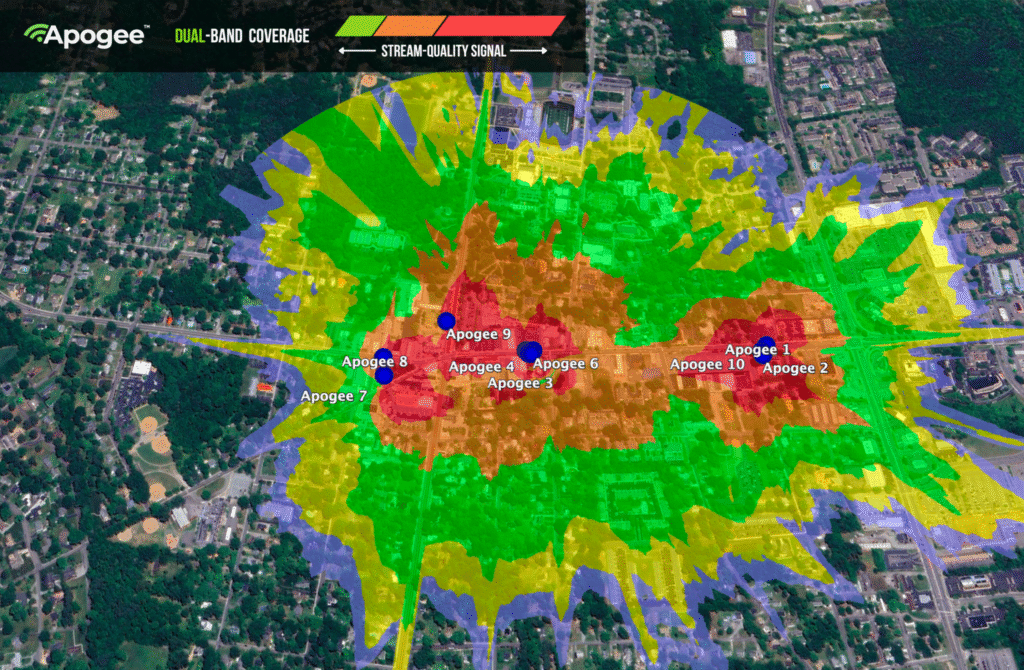
The town worked with its established IT partner, Communication Solutions Group, known as CSG. With Aura Wireless RF design support, CSG planned a municipal Wi-Fi deployment using 10 Apogee 360 antennas across 240 acres in the heart of Ashland.
The purpose was practical: give suitable mobile traffic another network path through Wi-Fi and improve connectivity where crews worked. The case describes that approach as carrier offload, with Wi-Fi taking some demand away from the cellular network.
Planning around the town’s working areas
CSG knew Ashland through its existing role as the town’s IT partner. As an authorized Aura Wireless system integrator, it brought that local understanding to the coverage project.
The source describes CSG reviewing coverage maps and the areas of greatest strain along Main Street. Aura supported the RF design. The plan placed 10 Apogee 360 antennas across the central coverage area, giving the project a defined footprint of 240 acres.
That local planning mattered because the town’s needs were tied to places and activities. Field teams needed access while moving through town. The project had to account for where those teams worked and how their devices would reach the wider network.
The antenna deployment was one part of that system. Network service, device access and the upstream connection still had to support the traffic the town intended to carry.
What municipal Wi-Fi contributes to carrier offload
Carrier offload uses Wi-Fi as another path for suitable traffic that would otherwise use the cellular network. An antenna helps provide coverage; it does not by itself move every device or service from cellular onto Wi-Fi.
At Ashland, Apogee 360 antennas supplied the coverage contribution for the planned areas. The connected radios and network services handled communication beyond the antenna. Device configuration and service support determine what traffic can use that path.
Apogee’s Asymmetric Gain helps the network receive lower-power device signals over the intended area. That return path matters for mobile equipment: a phone or tablet needs to send information back as well as receive it.
The source connects this receive-side behavior to the town’s expanded coverage. The practical result still depends on the installed system and site conditions. A coverage area alone does not establish the number of simultaneous users or the performance of every service.
Better access for the people working outside
After deployment, the account describes officers connecting more readily, EMS crews retrieving patient information and fire teams maintaining communication during field activity. It also reports improved connectivity for residents as traffic moved onto the additional network path.
These are reported operating improvements. The source does not provide carrier utilization measurements, incident statistics or a quantified response-time comparison. The deployment should be understood through its defined coverage footprint and the better access described by the project account.
The partnership is part of the result. CSG understood the town’s requirements and handled the integration role. Aura supplied antenna technology and RF design support. Together, they created a Wi-Fi coverage resource for the center of Ashland.
Questions about the Ashland deployment
How much of Ashland did the project cover?
The project used 10 Apogee 360 antennas to cover 240 acres in the heart of Ashland. That describes the project’s coverage area, rather than a claim that the entire town or every indoor location was served.
Who delivered the municipal Wi-Fi installation?
Communication Solutions Group, Ashland’s established IT partner and an authorized Aura Wireless system integrator, planned the deployment with Aura’s RF design support. CSG’s knowledge of the town informed the coverage plan.
Does an Apogee antenna replace a cellular network?
An Apogee antenna contributes Wi-Fi coverage to the installed network. Carrier offload also depends on suitable devices, network access and service configuration. The Ashland case does not establish that an antenna replaces a cellular network or public-safety radio system.
Explore Aura’s outdoor wireless network solution and how Apogee works. To discuss coverage for public spaces and field teams, contact Aura Wireless with the intended service areas, device needs and local integration requirements.