
Legendz Way Distribution Solutions operates two warehouses totaling more than 900,000 square feet in the greater Dallas/Fort Worth area. Their newest facility, a 730,000 square foot building located in Mansfield, Texas, handles high-volume pick/pack, scanning, and logistics operations across a large racking environment with dock bays on both the north and south sides of the building.
Like many large distribution operators, Legendz Way needed wireless coverage that could keep pace with the full extent of the facility — not just the areas closest to the network infrastructure.
| Facility size | 730,000 sq ft. |
| Existing environment | 13 ceiling-mounted APs with limited warehouse coverage |
| Traditional full-coverage estimate | 40–45 APs |
| Aura design | 4 APs + 4 Apogee antennas |
| Aura deployment footprint | 8 total deployment units |
| Cabling strategy | Fiber concentrated along the north wall |
| Traditional five-year model | $264,712 |
| Aura five-year model | $43,942 |
| Projected five-year savings | $220,770 |
| Projected cost reduction | 83% lower five-year cost |
Legendz Way needed more than just stronger wireless coverage. It needed the freedom to use the building differently.
"Before Aura, our Wi‑Fi coverage affected how we used the building. Our scanning and pick/pack stations were concentrated on the south side because that is where the coverage worked best. Now that we have floor-to-ceiling and wall-to-wall coverage, we can look at using both sides of the warehouse, splitting operations more efficiently, and making better use of the space we already have."
Mike Muzyka, Co-Owner, Legendz Way DistributionThe Hidden Cost of Partial Coverage
Partial coverage created an operating pattern before anyone chose it.
The existing Wi‑Fi worked well enough in some areas. That was part of the problem.
When a network fails everywhere, the issue is obvious. When it works in some places but not others, operations quietly adapt around it. Teams learn which zones are dependable, and storage decisions begin to reflect coverage constraints instead of operational logic.
That is what made the Legendz Way challenge bigger than a standard wireless refresh. The warehouse had usable coverage, but not full usable coverage. The south side of the racks became the practical center of scanning and pick/pack activity, while the north side had additional truck-bay capacity that could not be used with the same wireless confidence.
The network map had become the workflow map.
The north-side truck bays turned a coverage issue into an operating constraint.
The Traditional Answer Was More Infrastructure
A conventional full-coverage design would have solved the problem by adding more access points throughout the warehouse. Legendz Way's IT review validated that a traditional deployment would likely require 40–45 APs to provide full coverage.
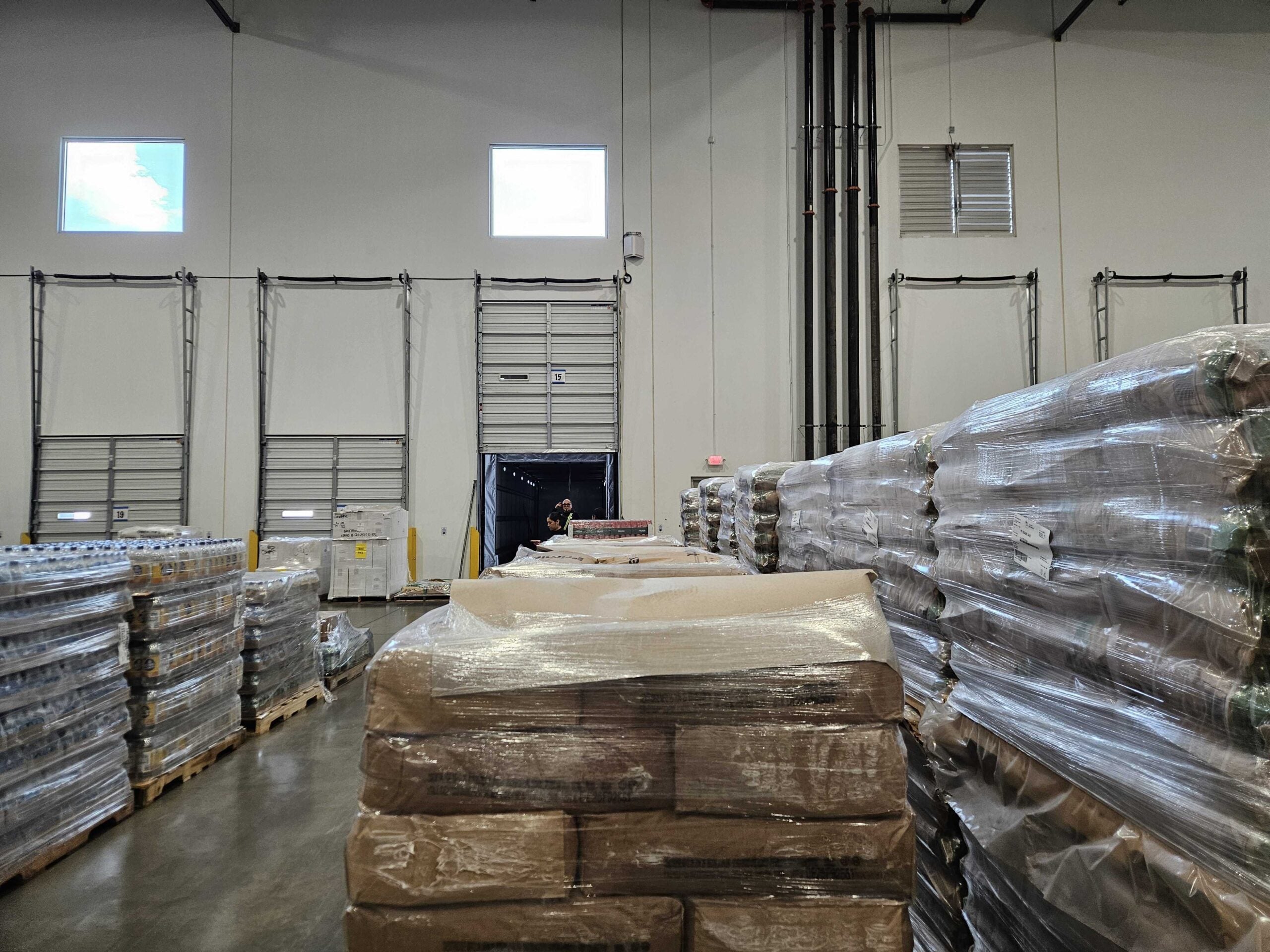
A 40–45 AP deployment would have required running Ethernet and fiber throughout the warehouse, including to locations deep in the racking field. Each additional access point also adds configuration time, lift rental, and the labor required to install and support the system.
For Legendz Way, the question became practical. Full coverage mattered. But did achieving it require turning the entire warehouse into a distributed cabling project?
The conventional path expands beyond AP count into cabling, switching, lift access, and support.
Aura Changed the Shape of the Design
Aura Wireless approached the warehouse from a different angle: reduce the number of infrastructure touchpoints needed to make the whole building usable.
Instead of treating every coverage gap as another access point location, Aura used Apogee antennas to extend and shape coverage from fewer infrastructure touchpoints. The final design used 4 access points paired with 4 Apogee antennas, creating 8 total deployment units.
Because of the warehouse's long footprint, the deployment concentrated fiber along the north wall rather than running infrastructure throughout the entire building. That simplified the physical design and reduced the number of locations that needed to be cabled, mounted, configured, powered, and maintained.
The difference was not simply fewer APs. It was a smaller physical footprint for the same operational goal.
That approach reflects a practical reality of warehouse Wi‑Fi: performance depends on both sides of the connection. The access point has to reach the device, and the device has to answer back across the areas where work happens.
Apogee is designed for that problem.
From Coverage to Operational Freedom
With coverage no longer deciding the floor plan, the operating conversation changed.
After the Aura deployment, the operating story changed.
Legendz Way now has floor-to-ceiling, wall-to-wall coverage across the warehouse. Instead of concentrating scanning and pick/pack activity on the south side of the racks, the team can evaluate splitting workflows across both sides of the building and making better use of the north-side truck bays.
That is the business value of coverage at warehouse scale: the building becomes more flexible.
Storage can be planned around operational need instead of wireless limitations, and pick/pack layouts can evolve as the business grows.
"This is exactly why Aura exists. The value of warehouse Wi‑Fi is not measured only in signal strength or AP count. It is measured by what the business can do once the whole facility becomes usable. At Legendz Way, Apogee helped turn coverage into operational flexibility."
Elaine Healy, CEO and Co-Founder, Aura WirelessThe business could reconsider how both sides of the warehouse should be used.
The Five-Year Cost Difference
Here is the full five-year comparison behind the business case.
| Five-Year Cost Model | Traditional Full-Coverage Design | Aura Design |
|---|---|---|
| Deployment architecture | 45 APs | 4 APs + 4 Apogee antennas |
| Total deployment units | 45 AP locations | 8 total deployment units |
| Cabling model | Broad Ethernet and fiber distribution | Fiber concentrated along the north wall |
| Five-year projected cost | $264,712 | $43,942 |
| Projected savings | N/A | $220,770 |
| Projected cost reduction | N/A | 83% |
The numbers matter because they show the operational result did not require the infrastructure footprint of a conventional 40–45 AP deployment.
Aura's five-year comparison used the 45-AP end of the traditional deployment range. That model projected a conventional design at $264,712 over five years, compared with $43,942 for the Aura design.
That represents approximately $220,770 in projected five-year savings and an 83% lower five-year cost.
Implications for Warehouse Leaders and System Integrators
Why It Matters for Warehouse Leaders
Warehouse leaders do not invest in Wi‑Fi because they want more radios in the ceiling. They invest because work needs to move without the network dictating the floor plan.
For operators, the lesson is practical: dock doors, scanning stations, storage locations, and pick/pack layouts need to remain flexible as demand changes.
When coverage reaches the full extent of the space, the building becomes easier to plan, staff, and adapt.
Legendz Way's deployment shows what happens when wireless design aligns with operational reality: a smaller, more practical full-warehouse design built around 4 APs and 4 Apogee antennas.
The result is a more usable space and a clearer path for operational change.
Why It Matters for System Integrators
For system integrators, Legendz Way is a useful example of how the warehouse Wi‑Fi conversation can shift.
Traditional warehouse Wi‑Fi planning often begins with AP density and coverage maps. Those are important, but in large industrial spaces every additional AP can also mean more cabling, switching, lift access, configuration, maintenance, and long-term support.
Aura gives partners a sharper way to frame the problem. The question is not only, "How many APs do we need?" The better question is, "How much infrastructure do we really need to make this building usable?"
At Legendz Way, that difference mattered: a smaller deployment, a lower five-year cost model, and a more flexible operating environment for the customer.
The Takeaway
Before Aura, Wi‑Fi coverage influenced where work could happen inside Legendz Way's warehouse.
After Aura, the team could plan around the operation instead of the coverage gaps.
That is the real outcome: not just fewer APs, lower cost, or better coverage on a map, but a warehouse network that supports the business instead of quietly shaping its limits.
Aura Wireless helped Legendz Way stop planning around coverage gaps and start planning around the operation it wanted to build.